
ESTABLISHING CAUSATION IN MOLD EXPOSURE CASES
California law permits physicians to establish causation in mold exposure cases through differential diagnosis without epidemiological studies. The Brancati decision confirms this methodology under the Kelly/Frye standard.
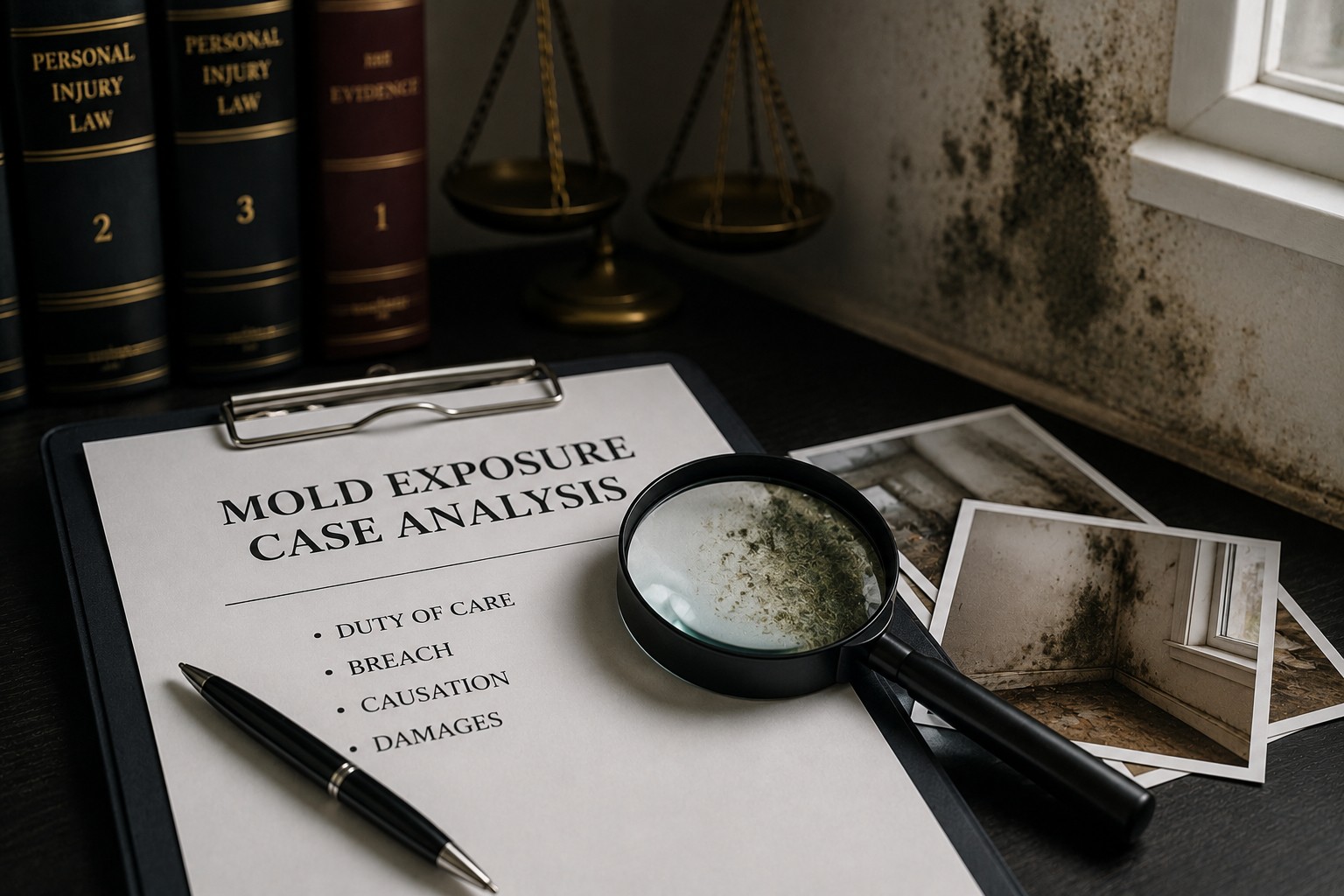
The Brancati v. Cachuma Village, LLC case establishes that under California law, a medical doctor may use differential diagnosis methodology to determine that mold exposure caused a patient's respiratory illness, and such testimony is admissible without requiring epidemiological studies showing a statistical link between mold exposure and the illness.
The court held that a physician examining a patient can rule out other causes through differential diagnosis and reach a probable diagnosis of mold exposure as the cause of diagnosed illness. See Brancati v. Cachuma Village, LLC, 96 Cal.App.5th 499 (2023).
Admissibility of Differential Diagnosis for Mold Causation
The Brancati court recognized two distinct methods for proving mold is the cause of an illness under California law.
First, an expert may testify using "a methodology generally recognized in the scientific community" to determine mold as the cause and may rely on epidemiological studies to show a statistical link between exposure to the substance and the illness. Alternatively, a doctor who examines a patient may use a medical "differential diagnosis" to determine mold as the cause of a diagnosed illness.
Physician Qualification to Diagnose Mold Causation
The Brancati decision held that as a medical doctor, the expert could rule out other causes with his differential diagnosis and reach a probable diagnosis of mold exposure as the cause of the plaintiff's respiratory illnesses. This holding relied on prior California precedent establishing that physicians may use differential diagnosis in toxic exposure cases.
Differential Diagnosis Methodology Standards
California courts have defined differential diagnosis as "a standard scientific technique of identifying the cause of a medical problem by eliminating the likely causes until the most probable one is isolated", citing Johnson & Johnson Talcum Powder Cases, 37 Cal.App.5th 292 (2019).
The process is not that complicated, but process involves two critical steps. First, the medical doctor, including an expert in allergy and immunology, must "compile a comprehensive list of hypotheses that might explain the set of salient clinical findings under consideration," determining which competing causes are generally capable of causing the patient's symptoms.
Second, the medical doctor must "engage in a process of elimination, eliminating hypotheses on the basis of a continuing examination of the evidence so as to reach a conclusion as to the most likely cause of the findings in that particular case".
The medical doctor should incorporate a thorough review of all relevant medical records, environmental evidence, and differential diagnosis to exclude non-mold alternative causes. A properly conducted differential diagnosis entails ruling out other plausible causes and identifying mold exposure as a probable cause of respiratory symptoms like nasal congestion, coughing, and exacerbation of migraine headaches consistent with the tenant’s environment and symptom onset.
The medical doctor’s testimony can be supported by peer-reviewed scientific studies showing general acceptance in the scientific community of a causal link between mold exposure and respiratory illnesses, satisfying the Kelly/Frye test requirements specific to California evidentiary standards.
Exclusion of such expert testimony based on the expert’s qualifications or methodology was deemed error by the appellate court when the expert followed accepted scientific procedures and tailored conclusions to case facts, including reviewing medical records, environmental mold testing reports, and symptom timelines.
The Brancati decision thereby affirms the admissibility of well-supported expert opinions on mold exposure causation under California’s Kelly/Frye framework and recognizes the validity of differential diagnosis in establishing specific causation in toxic mold cases.
Burden of Proof and Causation Standards
Under California law, a plaintiff need not establish the product or exposure as the proximate cause of injury with absolute certainty so as to exclude every other possible cause, even when the expert's opinion was reached by performance of a differential diagnosis. See Pilliod v. Monsanto, 67 Cal.App.5th 591.
Instead, the plaintiff must offer an expert opinion containing "a reasoned explanation illuminating why the facts have convinced the expert, and therefore should convince the jury, that it is more probable than not that the product was a cause-in-fact of the disease". The burden then shifts to the defendant to prove the existence of an alternative explanation supported by substantial evidence, not mere speculation.
In summary, Brancati confirms that differential diagnosis is a valid and admissible methodology under California law for establishing that mold exposure caused a plaintiff's illness, without requiring epidemiological studies, provided the physician properly rules out alternative causes through accepted medical diagnostic techniques.
For additional information or a confidential evaluation, contact McGonigle Law at (800) 713-5260.
Solutions
Your Attorney Failed You. Don't Let the Clock Run Out Too.
California's statute of limitations for legal malpractice is strict. Every day you wait is a day closer to losing your right to recover. Contact McGonigle Law today for a free, confidential consultation — we'll tell you honestly whether you have a case.