

California's New Wildfire Smoke Standards for Homes
January 1, 2027, California homeowners whose houses survive a wildfire but fill with smoke, ash and soot will have something they never had before: a legal presumption that the fire caused the damage, and enforceable health standards for when the home is safe again.
Governor Gavin Newsom signed AB 1795, the Smoke Damage Recovery Act, on September 15, 2026. He signed its companion, AB 1642, the same day. Together they make California the first state to set smoke-damage testing and cleanup standards that insurers must follow.
Why standing homes became the hardest claims
The January 2025 Eaton and Palisades fires left thousands of houses standing but contaminated. The California Department of Insurance counted more than 42,000 claims from the fires, including more than 13,000 for standing homes with smoke damage (Insurance Journal).
With no statewide standard, each claim became a fight over whether the smoke came from the fire, whether testing was needed and when cleanup was "done." Testing by Eaton Fire Residents United found lead, asbestos and heavy metals in homes even after professional remediation (LAist). Insurance Commissioner Ricardo Lara's Smoke Claims and Remediation Task Force concluded survivors were falling through the gaps in inspection, testing and restoration rules.
The rebuttable presumption
The core of AB 1795 shifts the burden of proof on causation. If wildfire smoke, ash, soot, char or other combustion byproducts are found in a surviving home inside the wildfire impact zone, the law presumes that fire caused the damage. An insurer that disagrees must prove otherwise.
The wildfire impact zone is defined broadly: any ZIP code that lies wholly or partly within the fire perimeter (Insurance Business).
Two limits matter for readers. First, it is a presumption about cause, not about damage. A homeowner still has to show contamination is present; the law does not assume every house in the zone was damaged (Insurance Journal). Second, "rebuttable" means an insurer can still overcome it with evidence, for example that the soot predates the fire or came from another source.
Lead, asbestos and who pays for testing
The lead and asbestos protections come from the two laws working as a pair. AB 1642, by Assemblymember John Harabedian (D-Pasadena), sets the health standards. AB 1795, by Assemblymember Mike Gipson (D-Carson), makes insurers follow them inside the impact zone.
- AB 1642 directs the Department of Toxic Substances Control and other agencies to develop guidance for restoring and safely reoccupying homes contaminated by wildfire byproducts, including lead, asbestos, cyanide and lithium (Hinshaw & Culbertson).
- AB 1795 requires insurers to pay for the sampling and testing needed to restore a home and clear it for occupancy (Insurance Business). Remediation and restoration are covered to the standard those health rules set, not to an adjuster's judgment.
- Policy limits, deductibles and exclusions still apply.
- The presumption covers cause, not whether damage exists.
- It does not give the Department of Insurance new enforcement powers beyond its existing authority over claims handling, according to Hinshaw attorney Lucy Wang, a former special counsel to Commissioner Lara (Hinshaw & Culbertson).
Before these laws, insurers generally were not required to pay for hygienic testing for toxins in smoke-damaged homes (United Policyholders). Until state standards are final, survivors can rely on standards a state or local health or environmental agency has already issued for a specific fire.
The state standards themselves will take time. DTSC has until the end of 2028 for lead and asbestos testing and cleanup standards, and until the end of 2029 for heavy metals and other pollutants (LAist).
Living expenses until the home is safe
Insurers can no longer cut off additional living expenses (ALE) while a smoke-damaged home is unsafe. Coverage must continue until the home has been restored and cleared for human occupancy under the AB 1642 health standards (Insurance Business).
This protection applies to wildfires declared a state of emergency (United Policyholders). It also remains subject to the policy's own ALE limits; the law stops early termination, it does not raise the dollar cap (Property Insurance Coverage Law).
Claim deadlines and adjuster rules
AB 1795 also puts insurers on a clock and raises the bar for who handles these claims (Insurance Business).
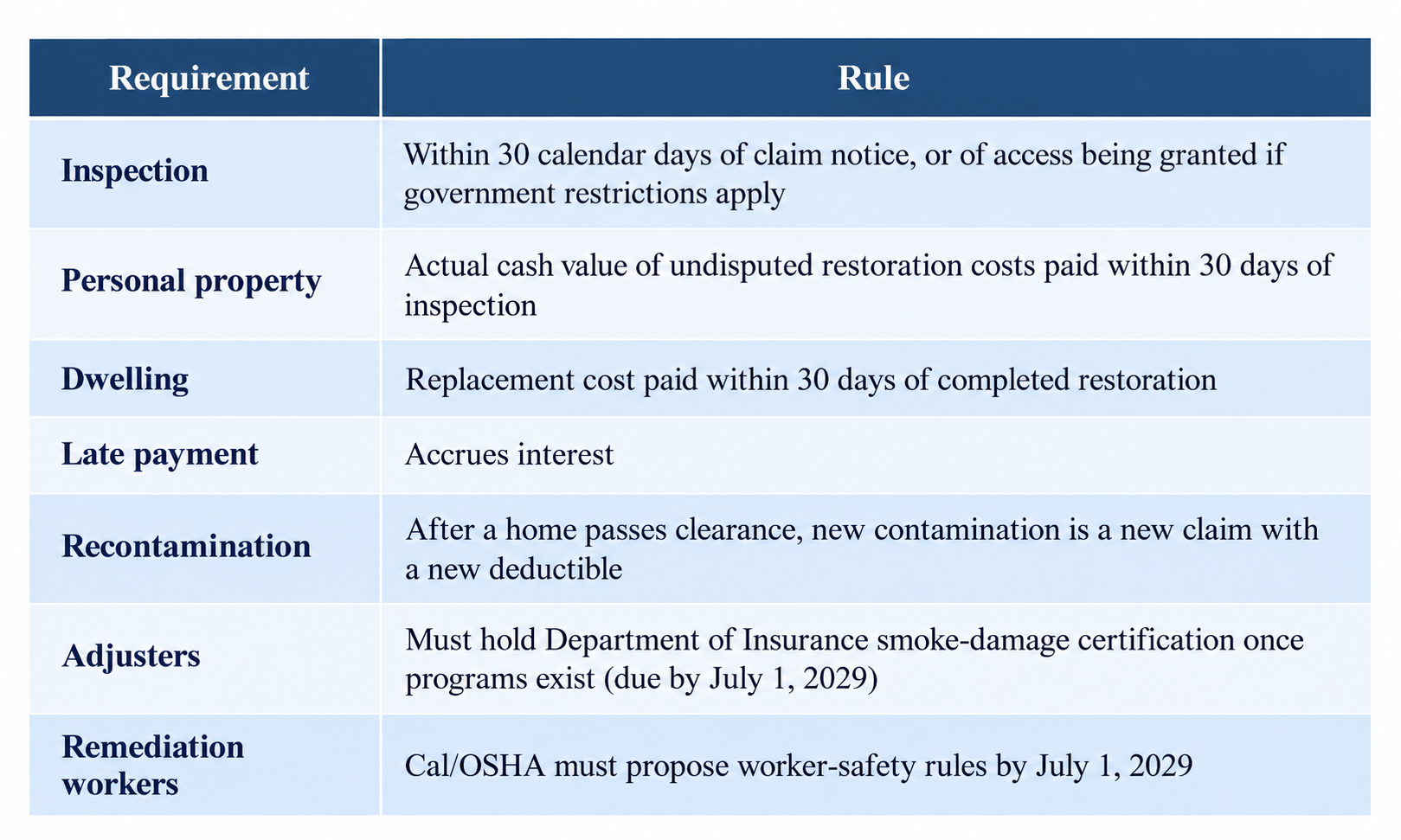
The law also orders a Department of Insurance report, due December 1, 2027, on coverage gaps exposed by the June 2026 Lineage Logistics warehouse fire in Boyle Heights. There, no mandatory evacuation was ordered, so most residents' policies did not pay temporary living costs.
What the law does not do
AB 1795 changes how smoke damage is proven and handled, not what a policy covers. In committee, Gipson said the bill does not change the "direct physical loss" standard and does not extend coverage to soil, outdoor areas or property the policy excludes (Assembly hearing transcript).
- Policy limits, deductibles and exclusions still apply.
- The presumption covers cause, not whether damage exists.
- It does not give the Department of Insurance new enforcement powers beyond its existing authority over claims handling, according to Hinshaw attorney Lucy Wang, a former special counsel to Commissioner Lara (Hinshaw & Culbertson).
Advocates also note the protections are only as strong as the final standards. Attorney Dylan Schaffer, who has sued the California FAIR Plan over smoke claims, called the bill a strong step but said the state's final testing and cleanup standards will matter most (United Policyholders).
Key dates and what homeowners can do
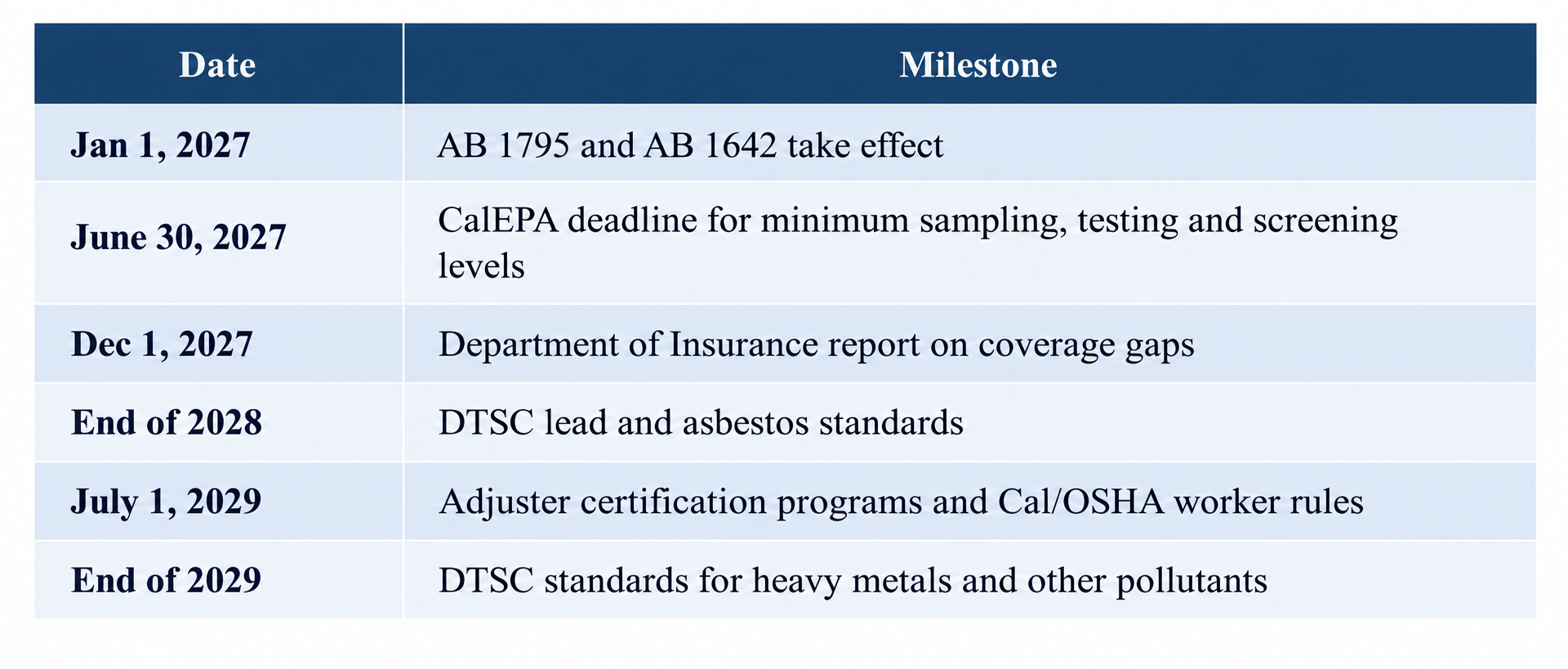
For homeowners with a smoke claim, a few steps follow from the new rules:
- Confirm whether your ZIP code falls within or touches the fire perimeter.
- Document soot, ash and char with photos and dated notes before any cleaning.
- Ask your insurer in writing to pay for lead and asbestos testing, citing AB 1795.
- Keep receipts for temporary housing and do not accept an ALE cutoff before the home is cleared for occupancy.
- Check whether your county or city health agency has issued fire-specific smoke standards you can rely on now.
This article is general information, not legal advice.
If you are having a dispute with your insurance company over fire related damages, contact the Law Offices of Timothy McGonigle for a free consultation at (800) 713-5260.

